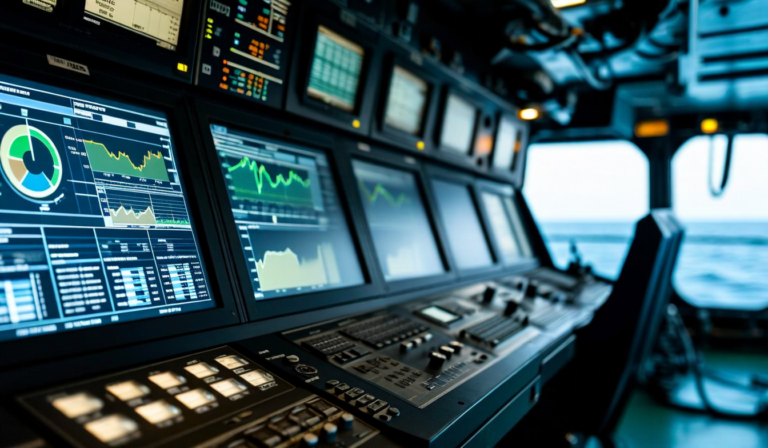
A main engine failure at sea is among the most costly events in commercial shipping. The vessel loses propulsion, potentially requiring a costly tow to the nearest port. Cargo delivery is delayed, triggering demurrage claims. The repair itself — often requiring spare parts flown to a remote location and specialist engineers mobilized at premium rates — may cost hundreds of thousands of dollars. And if the failure occurs in high-traffic waters, a loss of propulsion event triggers SOLAS reporting requirements and may attract Port State Control scrutiny.
Yet in most fleets today, maintenance is still managed on a calendar or run-hour basis: components are replaced after a fixed interval regardless of their actual condition, and failures are discovered when something stops working. The shift to condition-based and predictive maintenance — using continuous sensor data to assess the actual state of machinery and predict failures before they occur — is one of the most significant operational transformations available to fleet operators. It requires investment in sensors, connectivity, and analytics, but the financial case is compelling, and the technology has matured to a point where implementation is tractable even for small and medium fleets.
From Corrective to Predictive: The Maintenance Maturity Ladder
Maintenance strategies can be placed on a maturity ladder with four levels. At the bottom is corrective maintenance — fix it when it breaks. One step up is preventive maintenance — replace or service components on a fixed schedule. Both approaches are common in shipping and both have significant limitations. Corrective maintenance allows failures that could have been predicted and prevented. Preventive maintenance wastes resources replacing components that still have significant remaining life, and misses failures that occur before the scheduled interval.
Condition-based maintenance (CBM) is the third level: monitor the actual condition of components using sensors and diagnostic measurements, and service or replace them when condition indicators approach threshold values. This is already practiced informally by experienced chief engineers who listen for changes in engine sound, watch exhaust temperature trends, and check oil samples for metal particles. The fourth level — predictive maintenance — formalizes and extends this capability with continuous sensor data streams, machine learning models that detect subtle anomalies before they manifest as noticeable symptoms, and remaining useful life (RUL) prediction that enables planned maintenance at the optimal time.
The ship machinery environment presents particular challenges for predictive maintenance that don't exist in shore-based industrial settings. Space and power constraints limit sensor placement. The harsh environment — high humidity, salt air, vibration, temperature extremes — affects sensor reliability. Communication bandwidth is limited (satellite communication is expensive relative to shore-based industrial IoT), requiring onboard edge processing to filter and compress data before transmission. And the heterogeneity of fleet machinery — even vessels of the same class may have different engine variants, auxiliary equipment, and modification histories — makes it difficult to apply a single predictive model across all vessels.
Key Sensor Systems and What They Reveal
The main engine is the highest-value target for predictive maintenance on most commercial vessels. Modern two-stroke slow-speed diesel engines (the dominant type in commercial shipping) are instrumented with pressure sensors at each cylinder, exhaust temperature sensors, turbocharger speed and temperature sensors, lube oil pressure and temperature sensors, and jacket water temperature sensors. This instrumentation was designed for safety monitoring and alarm functions, but the same data streams, when analyzed with appropriate algorithms, reveal far more about engine health.
Cylinder pressure analysis is particularly powerful. The combustion pressure trace in each cylinder — measured by a cylinder pressure indicator or by a dedicated electronic pressure transducer — reveals the combustion characteristics with high fidelity. A cylinder with a worn or leaking injector shows a characteristic delay in the pressure rise. A cylinder with a degraded fuel valve shows reduced peak pressure. Comparing the pressure traces across all cylinders and against reference curves for the engine type reveals misfires, injection timing drift, and compression leaks that would otherwise only be discovered during manual indicator cock readings taken at a frequency that may be days apart.
Turbocharger health monitoring addresses one of the most common causes of main engine performance degradation. Turbocharger fouling — the accumulation of combustion deposits on turbine blades — progressively reduces boost pressure and increases exhaust back-pressure, with both effects reducing engine efficiency and increasing fuel consumption. Monitoring the trend in turbocharger inlet and outlet temperatures, shaft speed, and boost pressure enables detection of fouling before it becomes severe enough to affect engine power. Scheduled water washing of the turbocharger, timed based on condition data rather than fixed intervals, maintains optimal performance at minimum disruption.
Vibration Analysis and Rotating Machinery
Vibration analysis is the backbone of predictive maintenance for rotating equipment: pumps, compressors, fans, separators, and the shaft line. Every rotating component generates a characteristic vibration signature determined by its geometry and operating speed — the frequency components associated with bearing ball pass, gear mesh, shaft imbalance, and alignment are well-established in the machinery diagnostics literature. When these components begin to fail, their vibration signature changes in characteristic ways: bearing outer race defects produce a specific frequency pattern, gear tooth wear increases the mesh frequency amplitude, and shaft misalignment creates characteristic harmonics of the running speed.
Continuous vibration monitoring on critical pumps and compressors — using accelerometers mounted on bearing housings that transmit data to an onboard data concentrator — can detect bearing degradation weeks or months before catastrophic failure occurs. The practical consequence is the difference between scheduling a planned bearing replacement at the next convenient port call and suffering an unplanned pump failure at sea that may take the vessel off-hire for days. For high-criticality systems like sea water cooling pumps, steering gear, or cargo pump drives, this advance warning has obvious safety implications beyond the financial ones.
Shaft power measurement — using a torsiometer or shaft power meter that measures the torsional strain on the propeller shaft — provides both a performance monitoring capability (actual delivered shaft power versus fuel input reveals overall propulsion efficiency) and a condition monitoring capability (changes in shaft load patterns may indicate propeller damage or cavitation). Combined with flow meter data, shaft power measurement enables calculation of the actual fuel oil specific fuel consumption (SFOC) in grams per kilowatt-hour — the gold standard efficiency metric for main engine condition assessment.
Data Architecture: Edge Processing and Cloud Analytics
A practical predictive maintenance system for commercial shipping must address the data architecture challenge: high-frequency sensor data generated at sea must be processed efficiently, transmitted economically, and analyzed effectively. A modern vessel equipped with a full sensor suite may generate several gigabytes of raw data per day from machinery sensors alone. Transmitting this volume via VSAT satellite at sea would cost thousands of dollars per day — clearly impractical for most operators.
The solution is edge computing: an onboard data processing system that ingests raw sensor streams, runs algorithms to detect anomalies and compress normal data, and transmits only the results — summary statistics, anomaly alerts, and representative data samples — to the shore-based analytics platform. The onboard system stores the full high-frequency dataset locally (typically on solid-state storage with sufficient capacity for 30 – 90 days of data) for detailed analysis when the vessel is in port with broadband connectivity.
The shore-based analytics layer aggregates data across the entire fleet, maintaining historical baselines for each individual component, training and updating machine learning models on fleet-wide failure data, and generating fleet-level maintenance insights that help technical superintendents prioritize inspection and intervention across their vessel portfolio. Cross-vessel learning is particularly valuable: an anomaly pattern detected on one vessel's turbocharger may match a pattern that preceded a failure on a sister vessel six months earlier, enabling proactive intervention based on fleet-wide experience rather than just individual vessel history.
Implementation Roadmap for Fleet Operators
For fleet operators considering implementing predictive maintenance, the journey typically begins with data infrastructure before analytics. The first step is ensuring consistent, reliable data collection across the fleet — this may mean retrofitting sensors where existing monitoring systems have gaps, standardizing data formats and naming conventions across vessels with different automation systems, and establishing reliable data communication channels.
A practical starting point for most fleets is focusing on three to five high-criticality, high-failure-frequency systems: main engine fuel injection, auxiliary engine health, main sea water pump bearings, and turbocharger condition are typically the highest-value initial targets. Establishing baseline performance curves for these systems when they are known to be in good condition, and setting alert thresholds for deviation from baseline, delivers measurable value quickly without requiring sophisticated machine learning infrastructure.
As the data history grows — typically after 12 – 18 months of operation — the analytics capability can be expanded toward true predictive models. The combination of condition indicator time series with the maintenance log history (dates of bearing replacements, component failures, oil analysis results) enables regression and survival analysis models that predict time-to-failure with useful accuracy. Fleet operators who invest in building this data foundation now will have a significant analytical advantage over those who defer the investment — predictive models improve with more data, and the fleet that has three years of clean sensor history in 2027 will have substantially better predictions than one starting from scratch.