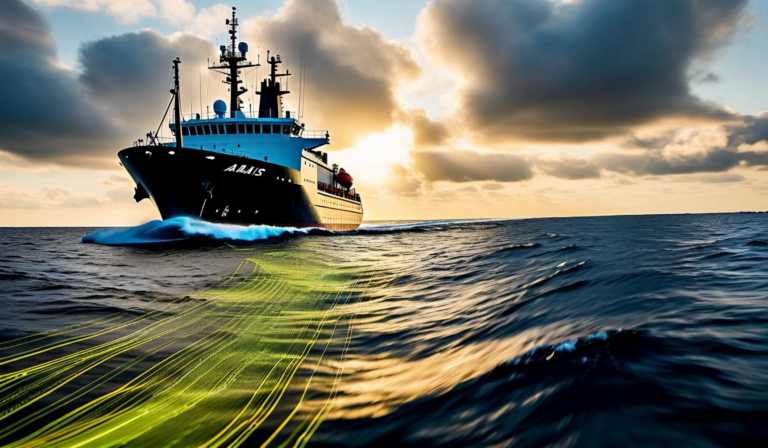
The Automatic Identification System: More Than Just Position Data
The Automatic Identification System (AIS) was originally designed as a collision-avoidance tool - a way for vessels and coastal stations to exchange position and identity information in near-real-time. What nobody predicted in the early 2000s was that the same protocol would become the primary data infrastructure for global maritime intelligence.
Today, AIS transponders are mandatory on all SOLAS vessels over 300 gross tonnage on international voyages, all cargo vessels over 500 GT, and all passenger vessels regardless of size. That requirement creates a global tracking network covering hundreds of thousands of commercial vessels at any given moment. But most fleet operators are using only a fraction of what this data stream actually contains.
An AIS message carries considerably more than a vessel's position. Each transmission includes the vessel's Maritime Mobile Service Identity (MMSI) number, its IMO number, call sign, vessel name, vessel type, dimensions, navigational status (underway using engine, at anchor, moored, etc.), speed over ground (SOG), course over ground (COG), heading, rate of turn, and destination. Class A transponders - fitted on larger commercial vessels - transmit every 2 to 10 seconds when underway and every 3 minutes at anchor. The density of this data stream, when processed correctly, tells a story that goes well beyond simple position reporting.
Terrestrial AIS vs. Satellite AIS: The Coverage Question
There are two fundamentally different ways to receive AIS signals, and understanding the difference matters enormously for fleet operations that extend beyond coastal waters.
Terrestrial AIS (T-AIS) uses shore-based receiver networks - antennas mounted on coastlines, lighthouses, port infrastructure, and VHF relay stations. Coverage is excellent within approximately 40 to 60 nautical miles of a coastline, depending on antenna height and atmospheric conditions. In congested shipping lanes like the English Channel, the Dover Strait, or the Singapore Strait, terrestrial networks can handle thousands of simultaneous transmissions per hour.
The problem is the open ocean. Once a vessel moves beyond terrestrial range - roughly 70% of ocean surface by area - T-AIS coverage drops to zero. This is where Satellite AIS (S-AIS) becomes essential. Low Earth orbit (LEO) satellite constellations from providers including Spire Global, exactEarth, and ORBCOMM capture AIS transmissions directly from space. The challenge with S-AIS is message collision: in heavily trafficked zones, multiple vessels transmit simultaneously on the same VHF channels, and the satellite may capture garbled or partial messages. Modern S-AIS processing uses signal processing algorithms and multi-satellite triangulation to resolve collision events and recover missing data.
For fleet operators managing vessels on transoceanic routes - North Atlantic container routes, Pacific bulk carrier crossings, or Indian Ocean tanker lanes - a data strategy that relies on terrestrial AIS alone is working blind for the majority of each voyage. As we discuss in our article on satellite AIS vs. terrestrial AIS coverage, the appropriate data architecture depends heavily on your fleet's geographic distribution.
What Real-Time Actually Means in Practice
The phrase "real-time AIS" is used loosely in the industry, and the variation in what it actually means is significant. Understanding the latency characteristics of your AIS data source is critical for any operational use case that depends on current vessel positions.
True real-time terrestrial AIS, delivered via a direct API connection to a well-maintained receiver network, can achieve latency under 30 seconds. This is the relevant time window for active traffic management, port approach coordination, and collision-risk assessment. Satellite AIS introduces additional latency - anywhere from 2 to 20 minutes depending on the satellite pass schedule and ground station processing pipeline. For most strategic fleet management use cases, this is entirely acceptable. For active vessel traffic service (VTS) operations at a port, it is not.
The Cetasol platform ingests both terrestrial and satellite AIS streams simultaneously and applies a data fusion layer that presents the most current reliable position for each vessel regardless of source. When a vessel is within terrestrial range, the platform uses T-AIS with sub-30-second updates. When it moves offshore, the system transitions to S-AIS and flags the longer update interval to operators. This transparent latency reporting matters: an operator who does not know whether their position data is 15 seconds or 15 minutes old cannot make accurate decisions.
The Five Operational Use Cases Where AIS Data Creates Direct Value
Most fleet management discussions focus on AIS for vessel tracking, but the operational leverage of a well-integrated AIS data stream extends considerably further.
Voyage performance monitoring. By combining AIS speed-over-ground data with charter party terms, operators can automatically flag vessels running significantly above or below contracted speeds. Speed deviations that persist for more than 6 to 8 hours typically indicate either a mechanical issue, an unreported deviation from the agreed route, or a deliberate slow-steaming decision that affects cargo arrival timing.
Port call ETA calculation. AIS-derived vessel positions, combined with historical speed profiles and weather forecast data, allow for dynamic ETA recalculation throughout a voyage. Static ETAs set at departure become increasingly inaccurate as voyages progress and conditions change. The Cetasol platform recalculates ETAs continuously and alerts port agents and receivers when the projected arrival window shifts by more than a configurable threshold.
Bunkering and fuel consumption estimation. Speed over ground data, combined with vessel displacement and engine load estimates, allows approximate fuel consumption calculations between waypoints. While this does not replace direct fuel flow metering for billing and regulatory purposes, it provides fleet managers with a real-time view of consumption trajectory against voyage budget.
Security and compliance monitoring. AIS manipulation - including spoofing, signal masking, and transponder deactivation - is a known evasion technique. Monitoring for vessels that exhibit unexplained position jumps, inconsistent speed/heading combinations, or periods of signal loss in low-risk areas is an increasingly important compliance function, particularly for operators managing chartered tonnage or participating in trade finance.
Fleet benchmarking. Aggregated AIS data from your own fleet, compared against peer vessels operating similar routes, enables meaningful benchmarking of speed profiles, port turnaround times, and routing efficiency. Without this comparative context, fleet performance metrics are difficult to interpret. As discussed in our article on vessel performance benchmarking, identifying outlier vessels requires a reference fleet to compare against.
Why Most Operators Are Not Getting Full Value from AIS
The gap between what AIS data can deliver and what most operators actually extract from it is largely an integration problem, not a data problem. Raw AIS feeds are voluminous - a global feed covering all commercial vessels generates hundreds of millions of messages per day. Processing that volume into actionable operational intelligence requires infrastructure and analytics capability that most shipping companies do not maintain internally.
The common failure mode is purchasing access to an AIS data API and attempting to build internal tooling around it. The result is typically a position map and a voyage history log - useful, but representing perhaps 20% of the analytical potential in the data. The remaining 80% requires time-series anomaly detection, multi-source data fusion, alert routing logic, and integration with voyage management and fleet administration systems that most operators already use.
This is the core value proposition of platforms like Cetasol: converting a raw AIS data stream into a structured operational intelligence layer that connects to the rest of your fleet management workflow. The position map is the entry point, not the destination.
Getting Started: What to Look for in an AIS Data Integration
If you are evaluating AIS data providers or fleet monitoring platforms, the following questions will help you assess whether you are accessing the full value of the data stream:
First, what is the actual update frequency and latency for your typical vessel routes? A provider that quotes "real-time" but cannot specify latency by geographic zone is giving you a marketing answer, not an operational one. Second, how does the platform handle signal loss and position interpolation? When a vessel enters a coverage gap, does the system clearly indicate that the position is interpolated rather than observed? Third, what data fields beyond position does the platform expose, and can you build custom alerts on navigational status changes, speed deviations, and destination updates?
The answers to these questions determine whether an AIS integration is a tracking tool or an operational intelligence platform. For fleet operators managing more than a handful of vessels across international routes, the difference between those two definitions translates directly into operational cost and decision quality.
See How Cetasol Handles AIS Integration
The Cetasol platform fuses terrestrial and satellite AIS with onboard sensor data to give fleet operators a complete operational picture. Request a demo to see how it works for your specific routes and fleet size.
Request a Demo Back to Blog